Notebook Buying Guide: Page Size, Ruling and the Pen You Already Use
Choose a notebook by how you write and where you carry it. Paper weight, page count and cover style are useful specifications, but the practical question is whether the complete book supports your ordinary notes without unnecessary bulk.
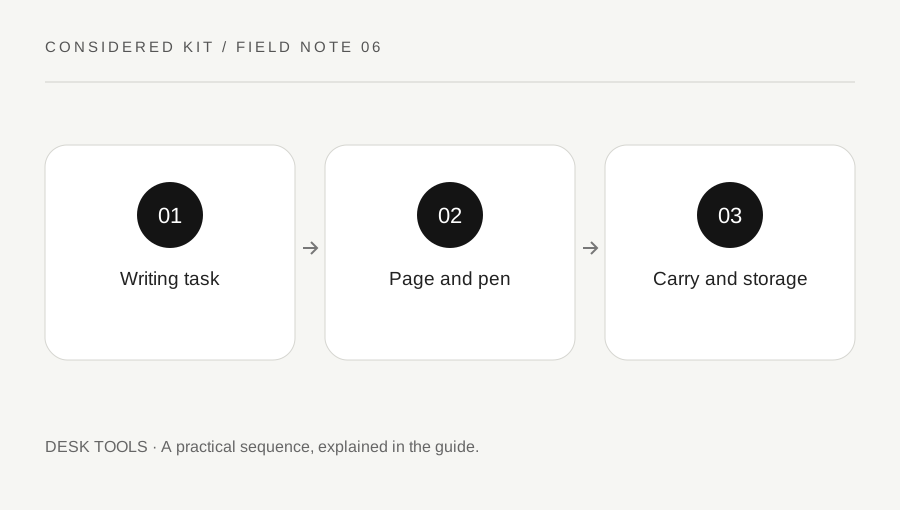
Original explanatory diagram. Examples illustrate a method or decision; they are not claims of personal testing.
Name the writing task before the format
Decide whether this book is for short observations, long handwritten drafts, diagrams or mixed notes. These uses need different amounts of visible page space. A pocket book may encourage carrying but frustrate someone drawing wide process diagrams. A large book may feel spacious at a desk but rarely leave the house.
Use a sheet of paper folded to candidate dimensions and write a normal entry. Do not only draw a rectangle and imagine it. In an illustrative comparison, a daily paragraph plus one sketch may fit a medium page while a narrow pocket format requires several turns. The useful size is the one that matches the task and your available surface.
Read actual dimensions and ruling
Check millimetres or inches rather than relying entirely on format names. Makers can use approximate or expanded format labels. Leuchtturm1917, for example, lists specific dimensions and ruling options for different products and notes that not every combination is offered. Verify the selected variant rather than assuming the photograph shows it.
Line spacing, dot spacing and margins affect how much writing fits. If you write large letters, tightly ruled pages may feel restrictive. Plain pages give freedom but provide no built-in baseline. Try a small sample with your normal handwriting, including a heading and any common table. A fashionable ruling is not a substitute for seeing whether your notes remain legible.
Match the paper to the real pen
Bring the pen or pencil you already use when a retailer allows a paper sample. Write a few ordinary lines, wait for them to dry and examine both sides under normal light. Look for show-through, ink spreading or transfer to the facing sheet. Those are different observations and can matter differently to a person writing on both sides.
Paper weight describes mass per area, not a universal guarantee of ink performance. Coating, fibre and the ink itself also matter. Manufacturer claims are useful starting points, but avoid buying a heavy book solely because a larger number sounds better. If no sample exists, read the stated paper specification and return terms while accepting that compatibility remains partly uncertain.
Compare binding, cover and page count
Open a sample as you would on the desk, rather than forcing the spine flat. Check whether the book stays comfortably usable at the beginning and end and whether the inner margin swallows writing space. A hard cover can support writing away from a table, while a flexible cover may be easier to pack. Binding behaviour varies by product.
Convert page count into your own expected use. If a notebook has two hundred numbered pages and you usually fill four pages a week, the simple arithmetic suggests about fifty weeks before allowing for indexes or skipped pages. This is a planning example, not a durability claim. A thinner book that you complete and archive may suit you better than a thick one carried for years.
Pay only for features you can name
Numbered pages, bookmarks, pockets and perforated sheets can be helpful, but each should have a role. If you remove pages often, inspect where perforations appear and whether the remaining book stays organised. If you archive notes, leave room for a clear date range and subject label. Avoid choosing a complex system just because the book includes many accessories.
Finish a comparison card with page dimensions, ruling, tested writing tool, page count and total packed weight if available. Choose one main book before buying several variants. Use it for a real week and record one problem to solve at the next purchase. That feedback produces a more useful specification than accumulating unused stationery for an ideal future routine.
A practical checklist
Choices are saved in this browser. Reset them here or clear this site’s browser storage.
Questions that come up
Is heavier paper always better?
No. It adds weight and does not by itself establish how a specific ink will behave. Match the paper to your writing tool and task.
Does every A5-labelled book have identical dimensions?
Check the maker’s exact measurements. Product names and approximate formats can differ.
Should I choose dotted pages?
Choose dots if they help your actual writing or diagrams. Ruled, squared and plain pages each suit different habits.
References & scope
Background references checked on 18 October 2026. Worked examples and diagrams are original teaching material.