Packing Cubes: Choose a Small System That Actually Fits Your Bag
Packing cubes are movable compartments, not an automatic way to double a suitcase's capacity. They can make a bag easier to unpack and repack when their dimensions suit the luggage and their categories suit the trip. Start with a small system before buying a large coordinated set.
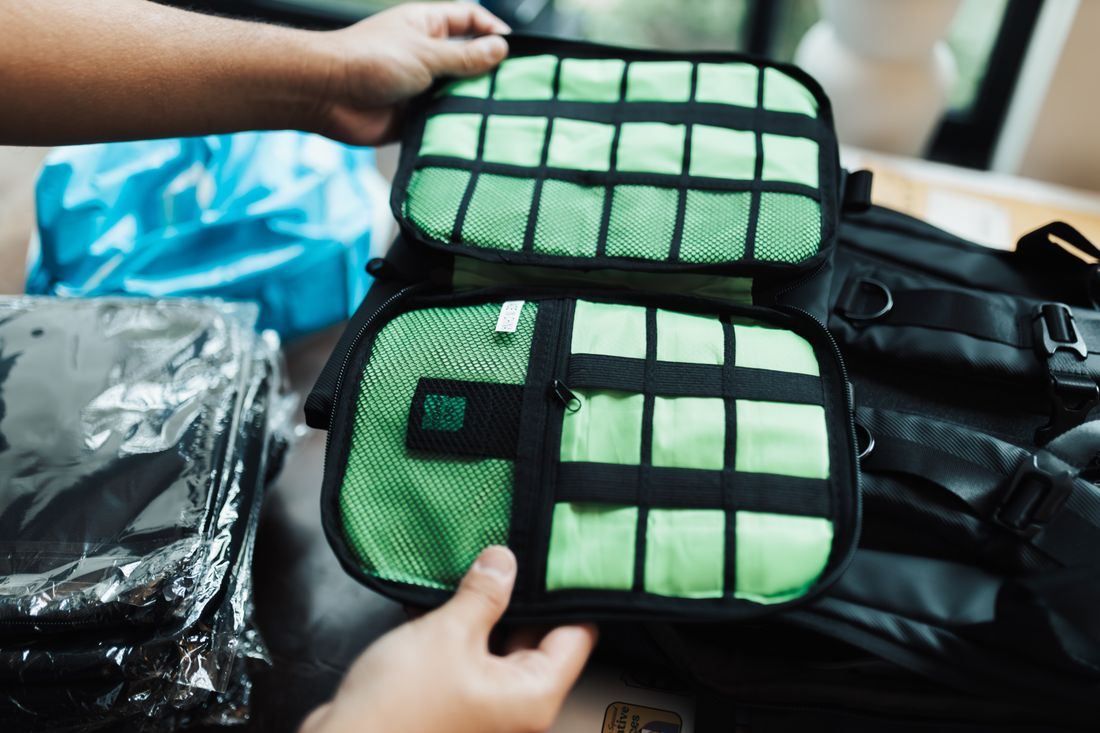
Photo: Matheus Bertelli · License. Illustrative stock photography.
Decide the problem the cube should solve
Perhaps small items scatter through a duffel, clothing shifts during travel, or you want to remove one category without unpacking everything. Name that problem first. If the bag is already simple to use, cubes may add unnecessary fabric and zippers. An organizer should improve retrieval, packing, or separation in a way you notice during the trip. It does not need to contain every object for the arrangement to be successful.
Measure the usable interior of the luggage
Check the real packing area with handles, wheel housings, curved corners, and built-in pockets taken into account. Compare the cube's filled dimensions, not just a flat product photograph. Several small rectangles may use space differently from one large cube, while leaving a flexible gap for shoes or a jacket can be useful. Avoid planning a perfectly tiled arrangement that works only when each cube is packed to an exact and unrealistic thickness.
Choose broad, memorable categories
Possible systems include tops and bottoms, one cube per person, or a few complete outfit groups. Small accessories can use an existing pouch instead of another full cube. Pick categories that remain understandable when you repack tired or in a small room. The ideal arrangement is not necessarily the one with the most separation. Too many categories create more zippers to open and more opportunities to leave an organizer behind in a drawer or cupboard.
Understand what compression changes
A compression zipper can reduce the thickness of some soft clothing loads, but it does not reduce their weight or make every fabric pack neatly. Structured garments, bulky seams, and overfilled corners may limit the benefit. Do not force a zipper against excessive pressure. Check the filled shape in the luggage and leave room to access adjacent items. A smaller packed cube can still be less convenient if it becomes a dense block that is difficult to arrange.
Compare visibility, opening, and cleaning
Mesh can help identify contents, while a less transparent panel may be preferable for privacy. A wide opening can simplify packing, but the cube must still be manageable in a small travel space. Read the care instructions rather than assuming every fabric organizer can go in a washing machine. Check seam finish, zipper movement, and any handles using the maker's information and a permitted inspection. These details matter more than a large count of included pieces.
Plan the return and the reset
Leave a suitable location for worn clothing and do not rely on a cube as a promise of odor or moisture protection unless the exact product supports that claim. Unpack after the trip, clean according to instructions, and dry organizers before storage. Store the smallest pieces inside a larger one only when they are clean and ready for reuse. A short inventory makes it easier to notice a missing cube before leaving accommodation.
Your working checklist
Checkmarks stay in this browser when storage is available. They do not submit a form or complete a booking.
Put it into practice
- Identify one recurring packing problem and gather the clothing affected by it. Try an existing pouch or reusable bag to see whether separating that category actually improves access.
- Measure the luggage's usable interior and compare filled organizer dimensions. Leave flexible space for rigid items, a last-minute layer, and the less orderly packing that happens on the return journey.
- Choose a few broad categories and pack a full trial load. Operate each zipper without forcing it, then remove and replace one category to test whether the system is genuinely easier to use.
- Write a quick departure inventory and decide where used clothing will go. After travel, empty and care for each organizer so the system starts the next trip complete rather than hiding leftovers.
Before you finish
- Packing problem is specific
- Filled cube size fits
- Categories are memorable
- Zippers close without force
- Used clothing has a plan
- Departure inventory is short
Common questions
Do compression cubes make luggage lighter?
No. They organize or change the shape of the contents but do not remove their weight. Check any applicable baggage weight limit independently of how compact the clothing looks.
Should I buy the largest set?
Only if every piece has a useful role and fits the luggage. A small number of well-sized organizers is often easier to maintain than a set containing several shapes you rarely use.
Can packing cubes replace a waterproof bag?
Do not assume that. Material, seams, closures, and the manufacturer's claim determine protection. Ordinary fabric or mesh cubes are organizers, and sensitive belongings may need appropriate separate protection.